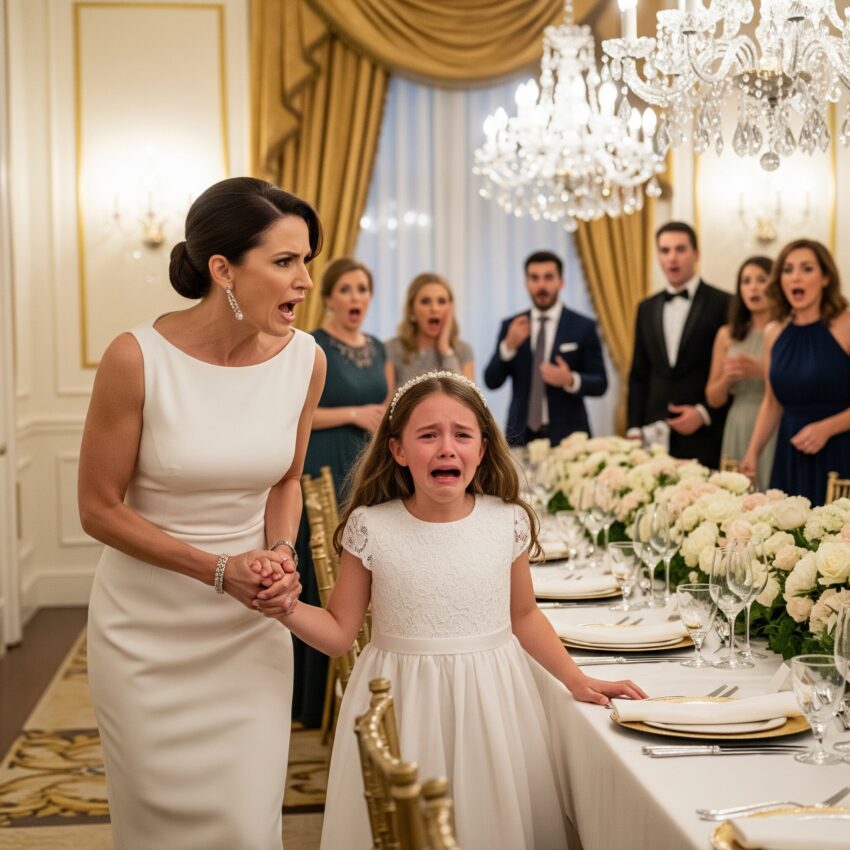

At Thanksgiving, there were nine place settings for ten people. My father pointed at my 12-year-old daughter and said, “You can eat in the kitchen. This table is for adults only.” She whispered, “But I’m part of the family… aren’t I?” Silence filled the room. No one spoke up for her. I didn’t argue. I simply took her hand, stood up, and walked out. What I did afterward ended up ruining their Christmas…..The dining room in my parents’ Connecticut home glowed under warm chandelier light, the table set with my mother’s best china. Nine place settings—polished silver, folded napkins, autumn-themed placeholders—sat arranged neatly around the oak table. Ten people were present. That detail hit me the moment we walked in from the kitchen, my daughter Ella’s hand still slightly cold in mine from helping my mother arrange pies in the fridge.
My father, Richard Holden, sat at the head of the table, a glass of cabernet already in hand though it was barely four in the afternoon. The room buzzed with the annual Thanksgiving tension—my parents’ subtle competitiveness, my brother’s forced cheer, my sister-in-law’s mild disapproval of everything, my mother’s perfectionism simmering just below her smile.
Then my father pointed at my twelve-year-old daughter.
“There aren’t enough seats,” he said. “Ella, sweetheart, you can eat in the kitchen. Adults only at this table.”
The room froze. A fork clattered somewhere near my brother Mark’s plate. My mother blinked rapidly, her smile faltering but holding. Mark looked away. His wife Karen pressed her lips together. My younger sister, Jenna, dropped her gaze to her phone.
I felt Ella stiffen beside me. She glanced up toward me, her brown eyes wide, her voice barely a whisper:
“But… I’m family too, right?”
It was the kind of question that split a room open.
Silence fell so thick I could hear the furnace kick on in the basement. No one challenged my father. No one invited her to sit. No one said the obvious—that of course she belonged there more than some of the adults who hadn’t lifted a finger all day.
I waited three seconds. Long enough for someone—anyone—to correct him. No one did.
I pushed my chair back slowly, the legs scraping loudly against the hardwood. Every face lifted toward me in confusion, irritation, or avoidance.
I didn’t raise my voice. I didn’t argue. I simply stood, reached for Ella’s hand, and said, “We’re leaving.”
My father scoffed. “Don’t be dramatic.”
But I was already guiding Ella toward the front door, grabbing our coats from the rack. Behind me, the room erupted in overlapping voices—my mother protesting weakly, Mark sighing heavily, Karen muttering something about “overreacting.”
I didn’t look back.
The door closed behind us with a soft thud.
What I did next—quiet, simple, and absolutely deliberate—destroyed their Christmas..The dining room in my parents’ Connecticut home glowed under warm chandelier light, the set with my mother’s best china. Nine place settings—polished silver, folded napkins, autumn-themed placeholders—sat arranged neatly around the oak table. Ten people were present. That detail hit me the moment we walked in from the kitchen, my daughter Ella’s hand still slightly cold in mine from helping my mother arrange pies in the fridge.
My father, Richard Holden, sat at the head of the table, a glass of cabernet already in hand though it was barely four in the afternoon. The room buzzed with the annual Thanksgiving tension—my parents’ subtle competitiveness, my brother’s forced cheer, my sister-in-law’s mild disapproval of everything, my mother’s perfectionism simmering just below her smile.