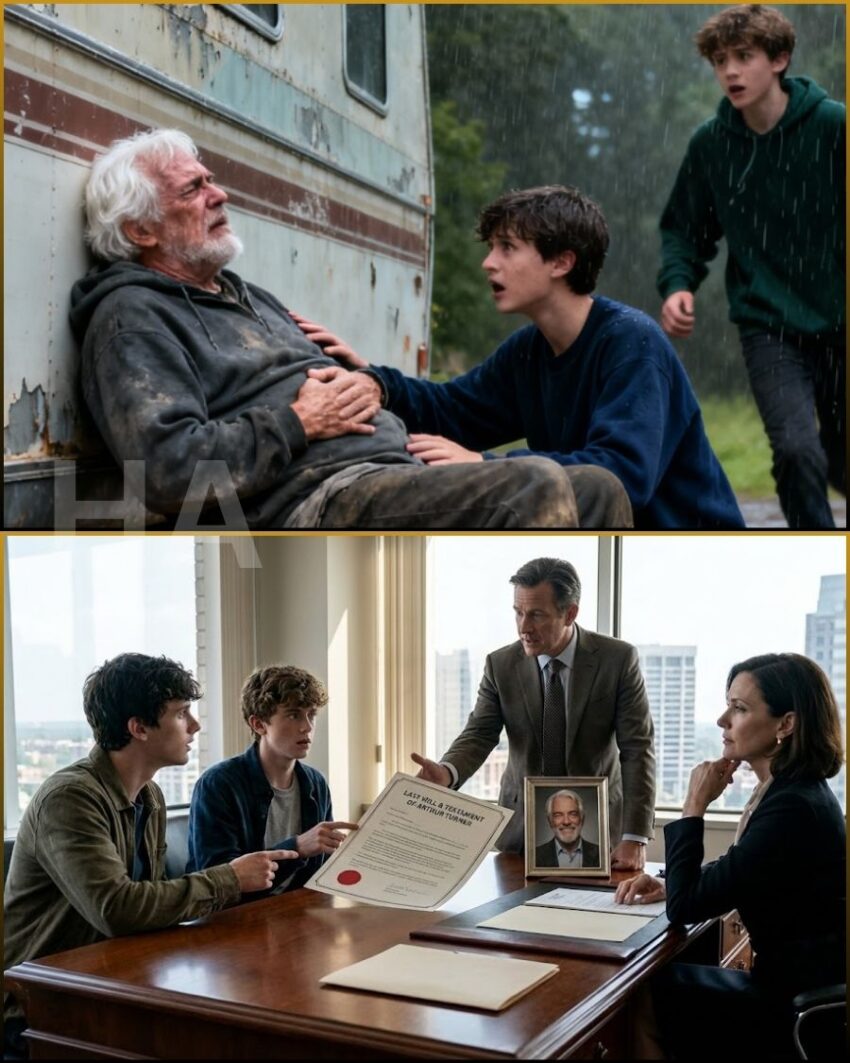
They followed him around a bend, through overgrown grass and puddles, until they reached a rusted metal trailer.
“You… live here?” Mason whispered.
Mr. Turner nodded, embarrassed. “I’m sorry you had to see it like this.”
“You don’t need to be sorry,” Ethan said gently.
“I want to repay—” He opened his wallet, then paused in humiliation. It was empty. Not even a single dollar bill. Instead, he grabbed one apple from the battered table inside the trailer and held it out with trembling hands. “It’s all I have.”
Mason shook his head. “We didn’t help you for that.”
Ethan placed the apple back on the counter. “Keep it. You might need it.”
When they left, the old man’s eyes were still watery.
They didn’t know then that this moment—this small act of kindness—would echo across years, eventually returning to them in a way they could never imagine.
The Visits
The following morning, the boys met at the same road.
“You thinking what I’m thinking?” Ethan asked.
“Yeah,” Mason said. “Let’s go.”
Between their saved lunch money, odd jobs, and a few dollars their mothers had insisted they keep for emergencies, they had enough to buy groceries and basic supplies. A little rice. Canned vegetables. Some bread. And scrap fabric to patch windows. Mason borrowed tools from his neighbor’s shed.
They knocked on Mr. Turner’s door that afternoon.
The old man cracked it open cautiously. When he saw the two boys—dripping rainwater, holding groceries—he froze.
“W-What is all that?”
“Just a few things,” Ethan said awkwardly.
“For your trailer,” Mason added. “And for you.”
The bags were stuffed. So full they were splitting at the handles.
“I… boys, I can’t accept—”
“Yes, you can,” Mason said with a grin. “We brought too much food. We’ll get in trouble if we bring it home.”
It was a terrible lie. But they told it well.
Mr. Turner’s eyes filled. “Why would you… do this?”
“Our grandma always said,” Ethan replied softly, “‘Love isn’t love unless you give it away.’”
The old man pressed his lips together, trying to compose himself. “May I… may I hug you boys?”
The embrace was gentle, shaky, full of gratitude.
That day became the first of many visits.
Twice a week—sometimes more—the boys stopped by. They helped repair the trailer. Fixed the roof. Replaced the cardboard with real glass Ethan salvaged from a junkyard. Mason dug a small drainage ditch so the home wouldn’t flood.
They cooked together sometimes. Other times, they simply talked.
Mr. Turner loved to tell stories. Not about money—not that he had any now—but about life, mistakes, regrets, and the people he had lost long ago.
“You know,” he said one evening, “a great man does the right thing when no one is watching.”
Mason smiled. “Sounds like a quote you stole.”
“No,” Turner chuckled. “That one is mine.”
Ethan asked, “Were you a teacher?”
“No,” Mr. Turner said softly, almost with shame. “But I wish I had been.”
They laughed, they listened, and they learned.
Mr. Turner wasn’t just a lonely old man anymore.
He was family.
The Disappearance
Spring arrived with thawed soil and blossoming trees. Ethan and Mason approached the trailer with their usual cheer and a basket of fresh fruit from the market.
“Mr. Turner?” Ethan called. “We got strawberries today!”
No answer.
Mason knocked again. “Mr. T? You in there?”
Silence.
The door creaked open when Ethan pushed it. The inside was empty. No blankets. No clothes. No food. The air felt cold.
“Where… where did he go?” Mason whispered.
They asked neighbors. They searched the woods. They went to the hospital. Went to the police. No one knew anything.
“He’s old,” one officer said coldly. “Sometimes people wander off.”
“But he wouldn’t leave without telling us!” Ethan yelled, anger rising in his throat.
Days turned to weeks.
Hope faded.
Even after everyone else gave up, the boys visited the empty trailer. Sometimes in silence. Sometimes leaving food on the step, hoping he would return.
He never did.
The Call
Two years passed.
The boys turned eighteen. They graduated high school with honors but had no money for college. Ethan worked at the grocery store; Mason coached Little League on weekends. They still walked past the old trailer sometimes. It remained empty—quiet, shrinking into the earth.
Then one morning, Ethan’s phone rang.
“Hello?”
“Is this Ethan Wells?”
“Yes.”
“My name is Jonathan Reed. I’m the attorney for Mr. William Turner.”
Ethan’s breath caught. “Mr. Turner? You found him?”
“I’m afraid…” The lawyer hesitated. “Mr. Turner has passed away. I need you and Mason to come to my office.”
The world felt like it stopped spinning.
He told Mason.
Both boys sat in stunned silence, grief rising like a slow tide.
Later that afternoon, they entered a small law office. A man in a suit greeted them.
“Ethan. Mason. Thank you for coming. Please, sit.”
Jonathan Reed placed a sealed envelope on the table.
“I’m sorry to tell you, Mr. Turner died two weeks ago. He had been sick for a long time.”
Ethan swallowed. “He never told us.”
“He didn’t want to worry you.”
The lawyer slid the envelope forward. “He left this letter for you.”
Ethan’s hands shook as he opened it. Mason leaned in close.
Inside was a message written in shaky handwriting.
“My dear Ethan and Mason,
If you are reading this, I am gone.
I am sorry I disappeared. I did not want you to see me suffer.
For most of my life, I lived with wealth but without love. I ran a company, once worth millions. But my family cared only for my money, not for me. After years of betrayal, I left everything behind. I chose a simple life in that trailer.