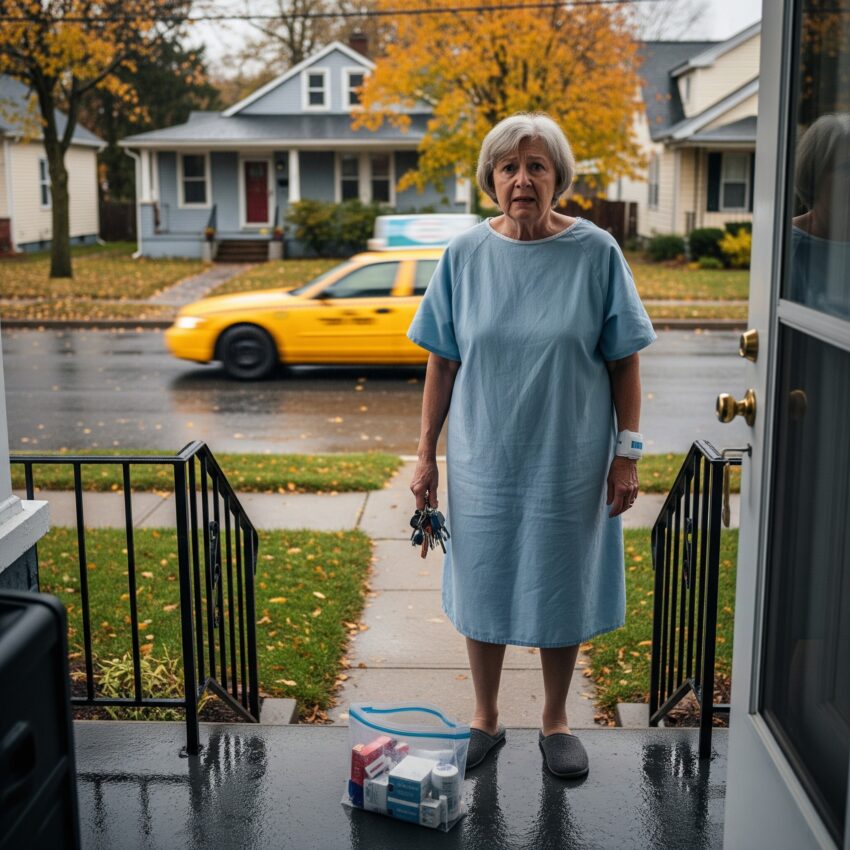
 After ten unanswered calls, my son still didn’t come to get me from the hospital. Fear drove me to ignore the ache in my wounds, grab a taxi, and head home—only to discover new locks on the door. A message taped to it read: “Don’t return. A leech isn’t welcome here.” I didn’t cry or plead. I didn’t need to. My late husband left me one last hidden advantage—and now, everything is about to change….The cab rolled away before I could steady myself, leaving me standing on the cracked sidewalk outside my own house in Bellevue, Washington. My stitches pulled sharply beneath my coat, a punishment for every shallow breath I took. I raised my hand to knock out of habit, but it froze mid-air when I saw the note taped to the door—neat handwriting I recognized immediately.
“Don’t come back. There’s no place here for a leech.”
The words hit harder than the fall that had sent me to the hospital three days earlier.
I checked the locks—changed. My son, Ethan Turner, had ignored ten calls, three voicemails, and one text I managed to send with trembling hands. That morning, I had been discharged early because the hospital needed the room, and I didn’t think twice about calling him for a ride. He promised he’d be there “in ten,” the same casual tone he used when he was fifteen and swearing he’d finish his chores.
He never showed.
My neighbors pretended not to notice me lingering on the porch, bleeding dignity onto the welcome mat I had bought last Christmas. I slid down onto the top step, legs shaking, throat dry. I didn’t cry. I didn’t pound on the door. I just stared at the note until the words blurred like ink in rain.
People assume betrayal happens in loud moments—shouting, slamming doors, a single unforgivable blow. But sometimes it slips in quietly, in the space between two heartbeats, when you realize someone you raised, someone you sacrificed for, decided they were done with you long before you even knew there was a choice.
I reached into my purse, searching for something—anything—familiar. Instead, my fingers brushed an envelope I had almost forgotten. My late husband Michael had given it to me two weeks before he died, insisting I open it “only when you truly need it.”
At the time, I had laughed it off, too exhausted from grief and caregiving to play along with final-hour dramatics.
Now, sitting on the cold step outside the house I no longer belonged to, I opened the envelope with numbed fingers. Inside was a single key attached to a metal tag engraved with an address—and a handwritten line:
“If everything falls apart, start here.”
The address wasn’t in Washington. It wasn’t anywhere close.
It was in Austin, Texas.
And suddenly, for the first time in months, I felt a direction instead of despair.
I stood, straightened my coat, and limped toward the road.
The cab rolled away before I could steady myself, leaving me standing on the cracked sidewalk outside my own house in Bellevue, Washington. My stitches pulled sharply beneath my coat, a punishment for every shallow breath I took. I raised my hand to knock out of habit, but it froze mid-air when I saw the note taped to the —neat handwriting I recognized immediately.
“Don’t come back. There’s no place here for a leech.”