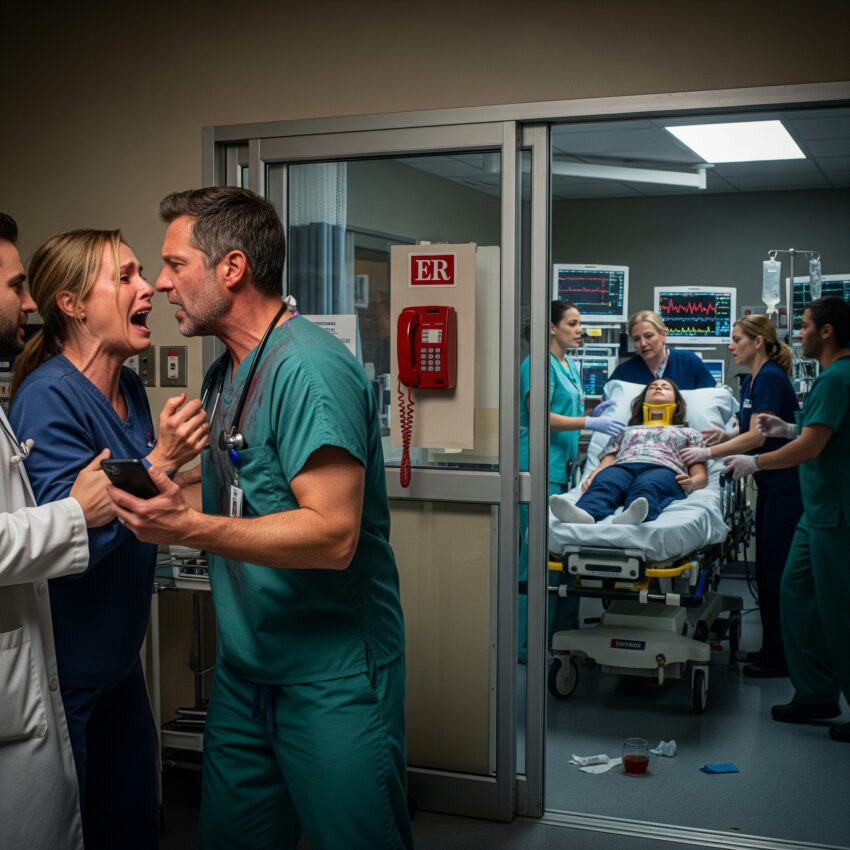
As my child’s life slipped away, I clashed with an ER doctor, exposed a deadly mistake, seized control, and triggered a desperate intervention that became the reason my daughter survived.
If I had arrived three minutes later, my daughter would have died.
People always assume that’s an exaggeration. I wish it were.
My name is Dr. Samuel Reed, trauma surgeon at Westbridge Medical Center in Colorado. After a 16-hour shift, my only plan was to collapse in the backseat of my car and sleep for ten straight hours. Instead, my phone buzzed with a call from my wife, Lauren, her voice shaking so violently that for a moment I couldn’t even recognize it.
“Sam—it’s Emily—the highway—she’s in the ER—they said—”
And then full-blown sobbing.
I didn’t ask questions. I just drove.
By the time I reached the Westbridge ER, I felt numb. The automatic doors slid open, and the first thing I saw was Lauren pounding on the glass window of Trauma Bay 3, screaming our daughter’s name. A security guard hovered nearby, unsure whether to intervene or pity her. Inside the bay, I caught a glimpse of my 14-year-old daughter lying motionless on the bed, a swarm of nurses moving around her like frantic shadows.
“Lauren!” I ran to her.
She spun toward me, mascara streaked down her cheeks. “Sam, he’s refusing to operate! He said she won’t make it! He’s leaving her to die!”
I turned to the young ER attending standing beside her. Slim, tired eyes, badge reading Dr. Nathaniel Brooks. He looked like he’d been awake for two days straight, the kind of exhaustion that eats into judgment.
“Dr. Reed,” he began sharply, “I’m sorry about your daughter, but you can’t be in here. You’re emotionally compromised. We are doing everything we can for her.”
“What’s her status?”
“She has massive blunt-force trauma, suspected liver laceration, internal hemorrhage. Her blood pressure is crashing. Taking her to surgery now would kill her before she’s even prepped. We’re stabilizing first.”
Those words—we’re stabilizing first—felt like a slap.
“Show me her chart,” I demanded.
Brooks pressed his lips together but finally handed over the tablet. “Doctor to doctor, I’m telling you: she’s not ready for surgery. She’s not stable, and she may never be stable enough. I need you to step back.”
I scanned the information. Vitals plummeting. GCS fluctuating. Tachycardia. Oxygen saturation dipping. But then I saw something else—something Brooks had either missed or dismissed.
Her neck veins were distended.
Her heart tones on the intake note were muffled.
Her pulse pressure narrow.
CVP spiking.
My stomach dropped.
“This isn’t just hypovolemia,” I said quietly. “She’s showing all three signs of Beck’s Triad.”
Brooks frowned. “That’s unlikely. The FAST was inconclusive—”
“It’s cardiac tamponade,” I snapped. “Her heart isn’t beating because it’s being crushed. You’re wasting time trying to stabilize what can’t stabilize without decompression!”
Brooks folded his arms. “With her blood pressure at 70 over 38, opening her chest is suicide.”
“Not opening it is murder.”
“Doctor Reed,” he said firmly, “you are her father, not her attending. Step back or I will call security.”
For a moment, all I heard was the rhythmic beeping from Emily’s monitor—slower now, weaker. My world was collapsing in real time.
Lauren clutched my arm desperately. “Sam, do something! Please!”
I reached into my coat pocket and pulled out my phone.
Brooks snorted. “Who are you calling? Risk management?”
I hit a single number on speed dial.
“No,” I said. “I’m calling Dr. Leonard Hale, the Chief of Cardiothoracic Surgery.”
Brooks blinked. “Hale? He’s lecturing in Boston.”
But before he could finish the sentence, the wall-mounted emergency line behind him began ringing—fast, piercing, unmistakably urgent.
Brooks stared at the phone, then at me, disbelief draining the color from his face.
“Answer it,” I said.
His hand trembled as he picked it up.
“This is Dr. Brooks…”
If I had arrived three minutes later, my daughter would have died.
People always assume that’s an exaggeration. I wish it were.
My name is Dr. Samuel Reed, trauma surgeon at Westbridge Medical Center in Colorado. After a 16-hour shift, my only plan was to collapse in the backseat of my car and sleep for ten straight hours. Instead, my phone buzzed with a call from my wife, Lauren, her voice shaking so violently that for a moment I couldn’t even recognize it.