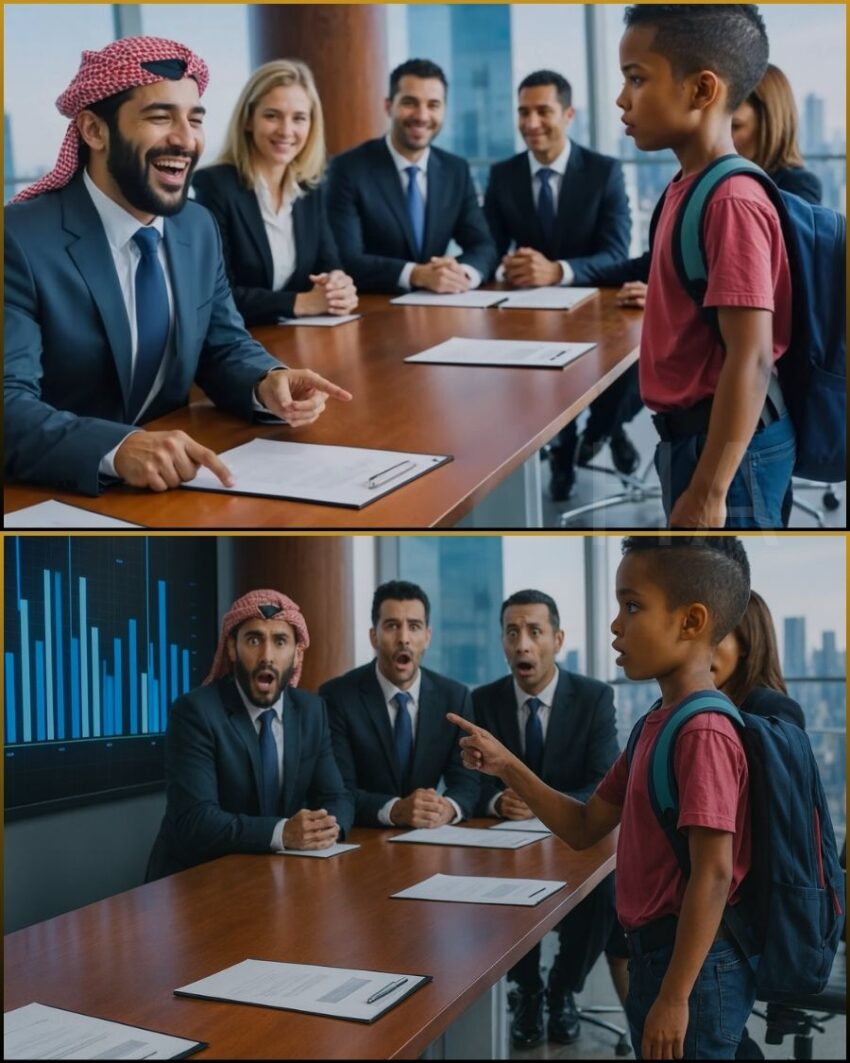
The laughter echoed through the glass walls of the Manhattan penthouse like a cruel thunderclap.
“Nine languages?” Hassan al-Mansuri scoffed, his baritone voice dripping with condescension. “Kid, you can barely speak English.”
At the far end of the office stood David Johnson, a 14-year-old boy with dark skin, intelligent eyes, and a public-school backpack hanging loosely from one shoulder. His mother, Grace Johnson, clutched her cleaning bucket beside him, her hands trembling. She had made the mistake of bringing her son to work, thinking she could keep him in a corner with a book while she finished polishing the billionaire’s floors.
But now her son’s words — “I speak nine languages” — had turned the oil tycoon’s amusement into ridicule.
The Challenge
Hassan, a 48-year-old Arab billionaire who owned a $3.5 billion energy empire, leaned back in his leather chair. He loved these moments — when power was visible, when he could toy with people who depended on his favor.
“Tell me then,” he said mockingly. “What are these nine languages you supposedly speak, boy?”
David looked him in the eye. “English. Spanish. French. German. Arabic. Mandarin. Russian. Italian. And Portuguese.”
The laughter stopped for a heartbeat. The boy’s pronunciation — especially of Arabic — was so flawless that Hassan frowned. For the first time, doubt flickered across his face.
“Liar,” Hassan snapped, forcing a chuckle. “Grace, your son’s fantasies are getting out of hand. Maybe take him to a doctor before he starts claiming he’s president.”
Grace lowered her head. For five years, she had endured the man’s arrogance to keep food on the table. But this — watching her son mocked — hurt more than every insult she’d ever swallowed.
“Mom,” David whispered, touching her arm. “It’s okay.”
That calm voice. That composure. It unsettled Hassan more than defiance would have. “So you speak Arabic, do you?” he sneered.
David tilted his head slightly. Then, in perfect classical Arabic, he said quietly:
“الحق لا يحتاج إلى إذن ليتكلم.”
The truth needs no permission to speak.
The room fell silent. Hassan’s eyes widened. The grammar was advanced, the pronunciation flawless. No tourist could fake that.
“Where… did you learn that?” he asked.
“At the public library, sir,” David replied simply. “They have free language programs every afternoon.”
The Proof
“Anyone can memorize a phrase,” Hassan said, his voice faltering.
“You’re right,” David agreed, unzipping his worn backpack. “That’s why I brought these.”
He laid down three documents on the billionaire’s marble desk:
– A certificate of proficiency from Columbia University’s community program.
– A municipal library diploma in advanced linguistics.
– A transcript from an online simultaneous translation course.
All stamped, signed, and dated. All real.
Hassan’s composure cracked. Impossible. He checked the seals. The ink. The paper. Every detail was authentic.
“This is fake,” he muttered weakly.
At that moment, David pulled out a tablet, opened a video chat, and greeted an Asian woman in fluent Mandarin. “Professor Chin, could you confirm to Mr. Al-Mansuri my performance in your translation course?”
The professor smiled through the screen. “David has been my best student in fifteen years,” she said in perfect English. “He is fluent in Mandarin like a native of Beijing.”
Hassan ended the call abruptly, his hands shaking.
The Revelation
“You’re 14,” Hassan whispered. “How is this possible?”
David smiled for the first time. “When my mom lost her second job during the pandemic, we couldn’t afford private school anymore. So I used public libraries instead of tutors. They had internet, books, and time — all I needed.”
Hassan felt a pang of shame. His own children had private tutors who cost $400 an hour. Yet this boy, without money or privilege, had achieved far more.
“But why languages?” he asked.
David’s gaze was steady. “Because when you speak to people in their own language, they stop seeing you as a stranger. They start seeing you as human.”
For the first time in years, Hassan had no response.
The Secret
“Why did you come here today?” Hassan asked finally. “You risked your mother’s job.”
“Because I heard you on the phone yesterday,” David said calmly. “You were negotiating with Arab investors — but you made mistakes that could cost millions.”
Hassan froze. “What mistakes?”
“You said Mubashir when you meant Mustajil, changing the meaning from ‘urgent’ to ‘immediate broadcast.’ And you confused Miraik with Miraib while setting deadlines.”
The billionaire turned pale. Those subtle errors had confused his investors — he’d just assumed the connection was bad.
“How did you know this?”
“Because I’ve studied business Arabic for two years,” David said. “It’s my specialty.”
He opened another folder — a detailed proposal analyzing Al-Mansuri Industries’ communication flaws and recommending linguistic improvements.
Hassan flipped through the pages. The analysis was meticulous, professional — worth hundreds of millions in recovered contracts.
“Why would you do this?”