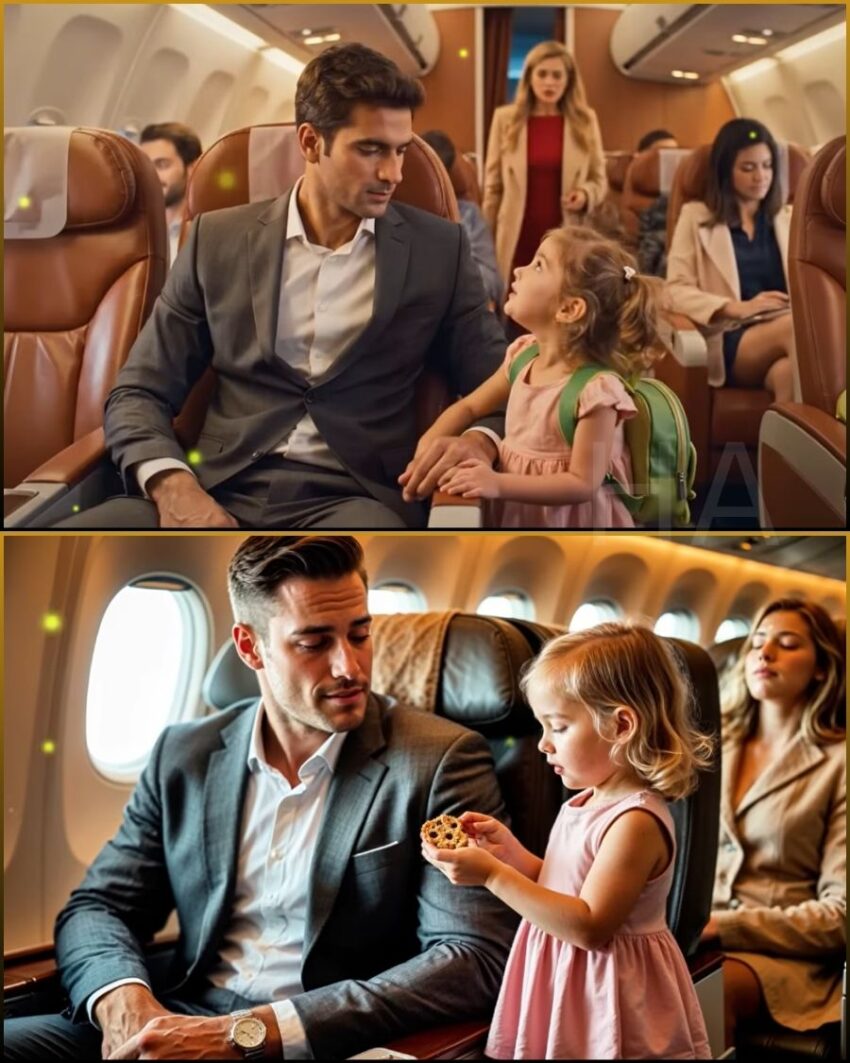
 “You Look Tired, Sir,” Said the Little Girl on the Plane—The CEO Didn’t Expect That She’d Change…
Half a Cookie at 30,000 Feet
Nathan Hail hated red-eye flights.
He hated the recycled air that dried his throat, the cramped seats that creaked with every shift, and the way exhaustion clung to him like a shadow he couldn’t shake. As CEO of a growing tech conglomerate, he was used to control — meetings that ran on schedule, assistants who anticipated needs, cars that arrived before he called them. But tonight, at 11:42 p.m., wedged into seat 18C on a commercial flight from Seattle to Boston, he had no such comfort.
First class was full. The universe, apparently, didn’t care who he was.
Nathan adjusted the cuff of his navy coat, exhaled, and stared out the window. The hum of engines matched the static inside his mind — numbers, deadlines, media chatter. He looked every bit the high-powered executive: tailored suit, sleek shoes, a watch that cost more than most people’s rent. But his reflection in the glass betrayed the truth. The lines around his eyes were deeper, the tension in his jaw sharper. He looked like a man who hadn’t slept properly in months.
He unfolded a newspaper, pretended to read, and tried to ignore the ache behind his temples.
Then came the shuffle of small feet.
A little girl — no older than three — appeared in the aisle, wearing a bright pink dress and a green turtle-shaped backpack that looked far too big for her tiny frame. “That’s our seat, Mommy!” she chirped. “The one with the window!”
Her mother smiled wearily and gestured her forward. The child climbed into the middle seat beside Nathan, sneakers tapping the chair in front of her with innocent excitement.
Nathan offered a polite nod and turned to the window again, hoping she’d lose interest.
But then came the voice — small, soft, and startlingly direct.
“You look tired, sir.”
He turned. The girl was watching him with enormous blue eyes, her expression sincere, not teasing.
“I’m fine,” he replied automatically.
She didn’t believe him — he could tell — but she only smiled and began digging through her backpack. From it, she produced a crumpled napkin and held out half a chocolate chip cookie.
“For you,” she said.
Nathan blinked. “That’s very kind, but I—”
“I have more,” she insisted, pressing it toward him.
Something in her openness disarmed him. Against his usual instincts, he accepted. “Thank you,” he murmured.
Her face lit up, and she went back to arranging her stuffed bunny for takeoff.
The plane rumbled down the runway, lights dimmed, and soon they were above the clouds. Nathan leaned back, cookie forgotten, eyes half-closed — until a small head came to rest against his arm. The girl had fallen asleep. Her mother, in the aisle seat, was already dozing, face turned toward the dim light, exhaustion etched deep into her features.
For the first time in months, Nathan felt something stir in his chest — a quiet warmth that wasn’t ambition or pressure or grief. It was… gentleness. Someone had seen him, not as a CEO, not as a headline, but as a tired man. And that someone was three years old.
When the plane landed at dawn, the spell broke.
The mother woke, startled, and whispered an apology as she lifted the girl — Sophie, he learned — from Nathan’s shoulder. She explained she was a nurse’s assistant, finishing three overnight shifts before catching this flight home. Nathan only nodded, saying softly, “No harm done. She’s wonderful company.”
The woman smiled, embarrassed and grateful all at once. “She thinks strangers are just friends she hasn’t met yet.”
He almost smiled. “I noticed.”
By the time they reached the gate, the crowd swept them apart. There were no numbers exchanged, no promises, just a nod and a memory — a little girl in a pink dress with a green backpack, waving goodbye.
Nathan told himself it was nothing. But he thought about them all the way home.
Boston greeted him with drizzle.
He rode silently in the black town car waiting at the curb, watching raindrops race down the window. His penthouse greeted him like a museum — immaculate, cold, impersonal. He poured himself a drink, stood before the window, and stared at the glittering skyline below.
On the shelf behind him sat a dusty photo frame. A woman smiled out from it — Emily. His wife. His best friend. The one who had loved him long before the money, before the boardrooms, before the headlines.
She had been gone five years now — a car crash on a rain-slick street.