The windshield wipers on Jasper Tate’s aging Civic beat an urgent rhythm against a curtain of October rain, but they couldn’t clear the guilt fogging his head. He had exactly eighteen minutes to clock in at Valmont Industries or Frank Morrison’s final warning would stick. He could still see Frank’s pudgy finger hovering over the time clock like a judge’s gavel. One more minute late, Tate, and you’re done.
Industrial Boulevard gleamed with slick steel and smeared headlights. Jasper merged, jaw clenched, telling himself that today—finally—would be a clean day. No breakdowns. No sick kid. No last-minute crisis. Just a paycheck that covered rent, June’s after-school program, and a little breathing room.
Then he saw the flash of orange through the rain.
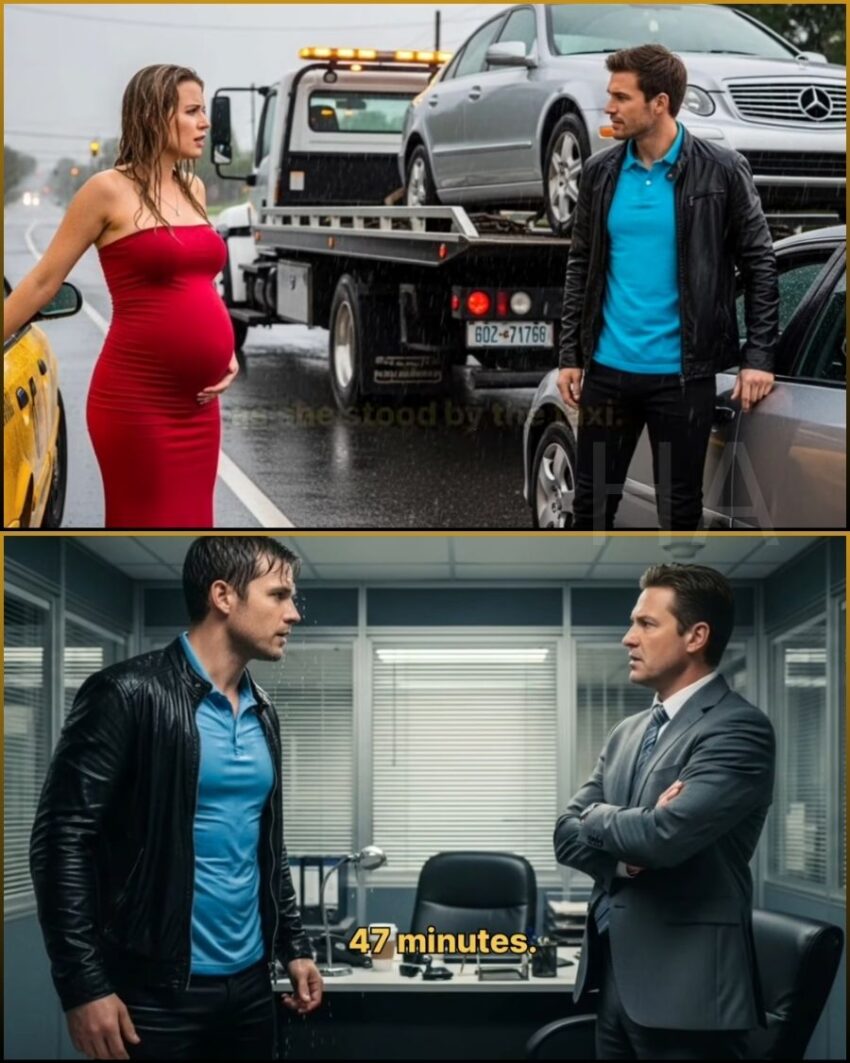
Hazard lights pulsed on the shoulder. A silver Mercedes idled with its hood up, steam feathering into the cold air. Beside it stood a woman in a short, soaked dress, one hand braced on the small of her back, the other cupped over a belly that was unmistakably pregnant. She was trying to make a phone call, hair pasted to her face, knuckles white against the glassy rain.
Jasper’s foot pressed the accelerator. Keep going. You can’t afford this. Not today.
She shifted, cradling her stomach, and something in him snapped back seven years in an instant: Claire in their tiny bathroom, palm spread over a life they could not yet imagine, eyes bright with fear and joy. He lifted his foot from the gas.
The Civic drifted to the shoulder. Jasper grabbed his umbrella, stepped into the downpour, and the cold found every seam in his jacket.
“Ma’am?” he called, jogging toward the Mercedes. “Are you okay?”
The woman turned. Up close, her face was finer than he’d expected—delicate bones, grave brown eyes—young, early thirties maybe, but with that watchful look people wore after life had taught them to hesitate before trusting.
“My car just died,” she said, voice trembling. “Roadside assistance says forty-five minutes.” She winced, both hands bracing the weight of her belly. The rain plastered the dress to her legs.
“Please,” Jasper said, angling the umbrella over both of them. “Sit in my car. It’s warm. You shouldn’t be standing out here.”
She studied him, long enough for the rain to run down Jasper’s collar. “I don’t even know you.”
“Jasper Tate,” he said gently. “Valmont Industries—logistics. Started three weeks ago. I have a daughter, June. She’s eight. I—I know what matters when someone’s pregnant.”
Something in her gaze eased. “I’m Abigail,” she said. “Thank you.”
He settled her into the Civic, cranked the heat, passed her a fistful of napkins from the glove box. His watch said 7:51. Nine minutes. He breathed through the panic.
“When are you due?” he asked.
“Six weeks.” Her hand swept her stomach unconsciously. “First child. Prenatal appointment this morning. Figures the car would die now.” She tried for humor, but worry creased the corners of her eyes.
“It’s not a sign,” he said. “Engines fail. You’re doing everything right.”
“You’re kind,” she said after a beat. “Your wife must appreciate that.”
The words hit soft and hard at the same time. “My wife passed away,” Jasper said. “Two years ago. We manage.” He forced a smile. “June’s stronger than I am most days.”
They watched the rain stitch lines across the windshield. When he checked his watch again—8:02—he felt the floor drop out of his stomach.
“You should go,” Abigail said. “I’ll be fine.”
“I can’t leave you here,” he answered, and even as he said it he could see Frank’s reddening face, hear the way his coworkers’ conversation would stutter when security walked him out. He stayed anyway.
The tow truck took thirty-three minutes to arrive. Jasper helped move Abigail’s bag and phone, made sure the driver would drop her at the clinic. She squeezed his hand before he left. “Not many people would have stopped.”
“Take care of yourself,” he said. “Both of you.”
He drove away with her standing in the mirror, hand at her belly, rain beading on her hair. Something about the set of her mouth—troubled, almost premonitory—stuck with him all the way downtown.
Valmont’s lobby shone like a reflection pool when he trudged in at 8:47, water trailing from his hair onto polished stone. His badge beeped. He walked faster.
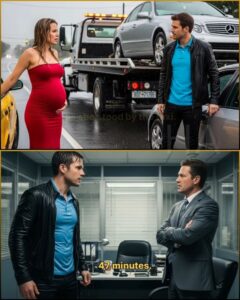
Frank was waiting at his cubicle, arms crossed, pink gone to purple. He didn’t say sit. He didn’t say anything friendly. He marched Jasper into a stale office that smelled like burned coffee and old anger.
“Forty-seven minutes late,” Frank said, each word clipped. “I warned you.”
“There was a pregnant woman on the road,” Jasper began. “In the storm. Her car—”
“Oh, a pregnant woman.” Frank laughed, a sound like breaking plastic. “This city’s full of them. You planning to stop for every one?”
“I couldn’t leave her.”
“You could. You should. You didn’t.” He plucked a manila folder from his desk with ceremony. “Three strikes. Pack your desk. Security will be here in ten.”
Jasper swallowed everything he wanted to say. Nothing would crack Frank’s shell. He packed a picture of June, the mug she’d decorated with unicorn stickers, a spindly succulent he’d been trying to coax back to life. His coworkers pretended their screens were very interesting. A guard hovered, bored.
When he stepped out into the light again, the rain had thinned to a drizzle, the sun flaring anemically behind the clouds as if to mock him. He sat in the Civic for twenty minutes with his forehead on the steering wheel, rehearsing the conversation with his daughter: The stability I promised? Not this month, kiddo. Maybe not next month either. His phone rang with a charge from June’s after-school program. He ghosted the call, ashamed.
Claire’s voice rose up out of memory, gentle as always: You did the right thing, Jas. We figure out the rest.
But Claire wasn’t here.
Two brutal days followed. Seventeen applications. Three disheartening calls. A bank account that looked like a countdown clock. June’s worried eyes peeking around his bedroom door.
Thursday afternoon, a knock. Not the landlord—it was a woman in a navy suit with a trimmed gray bob and a quiet authority that said she was used to opening doors simply by standing in front of them.
“Mr. Tate?” she asked. “I’m Janet Powell. Human Resources. Valmont Industries.”
Every muscle in Jasper’s body tensed. “If this is about paperwork, I—”
“Our CEO reviewed your termination,” Janet said, and slid an envelope onto his coffee table. “She found it unacceptable. You’re reinstated with back pay, effective immediately.”
Jasper stared. “I… what?”
“And,” Janet added, almost cheerfully, “Miss Cross would like to offer you a different role: executive assistant. Salary and benefits are detailed inside. Start date Monday, 9 a.m., executive floor.”
“Miss… Cross?” he repeated, as if the sounds would rearrange into a meaning he could hold. “I’ve never met her.”
“She has her ways,” Janet said with the faint, knowing smile of someone holding a secret that would make sense in time. “She pays attention to character.”
After she left, Jasper read the contract three times, eyes stinging. The numbers were real. The words were real. Nothing made sense.
Monday, his best tie. June stood in the bathroom doorway like a solemn little judge. “You look fancy,” she announced.
“New job fancy.”
“Are we okay now?”
“We’re okay,” he said, and meant it so hard his throat hurt.
The executive floor might as well have been a different planet: marble underfoot, the skyline stretched in glass, silence that meant money. A receptionist with movie-star hair walked him down a hallway of abstract art to a pair of oak doors and gestured him through.
The office was flooded with wintery light. A leather chair turned toward the windows. Jasper cleared his throat. “Miss Cross?”
The chair swiveled. His world tilted.
Abigail.
Not the rain-soaked stranger from the shoulder of the road but the woman the building belonged to: black suit cut clean, hair smooth, a presence that made the air behave. Her hand rested over a curve beneath the jacket that somehow looked regal rather than fragile.
“Hello, Jasper,” she said softly. “Surprise.”
He opened and closed his mouth like he’d forgotten how speech worked. “You—You’re—”
“Abigail Cross. CEO.” She offered a rueful smile. “On maternity leave. Or I was. Doctor’s orders: rest, reduce stress, prepare. But after you helped me, I couldn’t shake the feeling I needed to check on a few things.”
“You came back because—”
“Because I trust my instincts. They’ve kept this company alive.” Her expression cooled. “They also told me a man who risked being late in a storm to help a stranger might matter here more than a supervisor who treats people like timecards. I came in that evening and asked questions. When I learned you’d been fired, I had Janet pay you a visit.”
“Frank—”
“Has been reassigned,” she said, a measured answer that said enough. “We have policies. We also have values. The second matter more to me.”
Jasper sat because his legs made him. “I… thank you.”
“I owed you at least that much,” she said. “But honestly? I did it because it’s good business. Keep people with a spine. Weed out the ones who’ve forgotten their humanity.”
The first weeks remade his life in a blur. Abigail Cross worked at a tempo that would have blistered most people—brilliant, decisive, precise. Jasper learned to read her calendar the way he read June’s moods: where to build buffers, when to slide snacks across the desk, how to anticipate two moves ahead. He had never been so far out of his depth. He had also never felt so needed. Somewhere between briefing books and board packets, they started talking like people.
“Why did you really come back?” he asked one evening after eight, Chicago reduced to glitter through glass. The cleaning crew had come and gone. Abigail’s heels were off under the desk; she flexed her toes absently as she studied a chart.
“Because home was loud,” she said finally, hand splayed over her belly. “With my thoughts, I mean. Work is quieter.” She glanced at him. “This pregnancy is… complicated.”
“How?”
She turned a pen between her fingers for a long time. “Can I tell you something in confidence?”
He nodded.
“I chose to have this baby alone,” she said. “IVF. No partner. No father in the picture. I wanted a child more than I wanted the risk of trusting the wrong person again.” She spoke without self-pity, but the scars showed in the facts: work stolen by a college boyfriend; a fiancé who emptied her account to feed a fantasy; the last man who forgot to mention his wife. “Control felt safer than hope.”
“That’s not cowardice,” Jasper said. “It’s courage.”
“You’re the first person I’ve told besides my doctor.” She looked away, blinking. “You… care. Without keeping score. Not many people do that.”
He thought of Claire; of June; of the long, thin line that ran through his days now, binding duty to love. “I know what it’s like to be out on a ledge and need a hand.”
Three weeks later, the ledge gave way.
It happened on a Wednesday, calm snap-cut to panic. One second Abigail was marking up a contract, the next she gripped the edge of her desk, color draining. “Something’s wrong,” she gasped. “The baby.”
The rest was speed and muscle memory. Emergency bag. Coat. Elevator doors that would not close fast enough. Jasper’s hazard lights strobing blue on wet asphalt. Her hand crushed his on the ride. “Don’t leave me,” she said, and he promised the thing you can only promise when you mean it: “I won’t.”
At Northwestern Memorial, doors opened like the sea. Words flew: placental abruption, fetal distress, now. Jasper called Janet with his free hand, texted the neighbor about June with the other, drank vending-machine coffee that tasted like pennies, and watched the clock refuse to move.
At 2:47 a.m., a surgeon in scrubs came out with a face arranged into professional calm. “The operation went as well as we could hope,” he said. “Miss Cross is stable. Your son is in the NICU. He’s very early. The next hours are critical.”