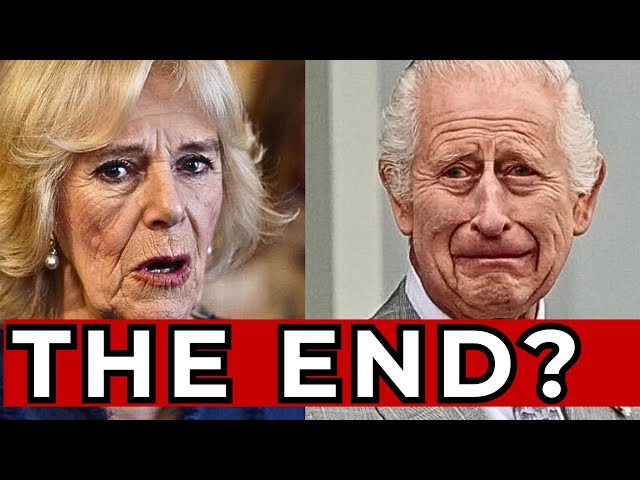
In an emotional and unprecedented moment for the British royal family, King Charles has tearfully confessed that his declining health has left him unable to fulfill his duties as monarch. “I’m sorry, I couldn’t do anything as my health continues to decline. The United Kingdom needs a new king,” the monarch said in a statement that has shocked the nation. As Charles’ condition worsens, the royal family—and the public—are now left to wonder who will step up to the throne. Will it be his wife, Camilla, or could another figure from within the royal family assume the mantle of leadership?
The somber announcement came during an emotional televised address, marking an extraordinary moment in British history. King Charles, visibly distressed, acknowledged the toll that his health issues have taken on him personally, as well as on his ability to lead the country effectively. “I never imagined that my reign would come under such circumstances,” he stated. “But I must face reality. The crown must pass to someone capable of carrying it forward.”
This dramatic turn of events has left many questioning the future of the monarchy and who is best suited to succeed Charles. The Queen Consort, Camilla, has been the subject of speculation ever since Charles ascended to the throne, especially given her long-standing relationship with the king. While traditionally, the consort’s role is not to inherit the throne, there have been discussions about whether Camilla could play a pivotal role in a transitional phase, guiding the monarchy during this uncertain time.
However, royal experts and insiders suggest that while Camilla has been a supportive figure for Charles, she may not be the one to take over the crown. Traditionally, the heir to the throne is the monarch’s eldest child, which means Prince William, the Prince of Wales, would likely be the first in line to succeed his father.
In fact, many royal watchers believe that it is Prince William who will take the throne if King Charles steps down. William, who has already proven his leadership abilities through his royal duties and charitable work, has long been seen as the future face of the monarchy. His popularity and ability to connect with the public make him a natural choice to lead the country into the future.
While the prospect of a king in his early 40s might be a shock to some, the British royal family has been preparing for such an eventuality for years. Prince William has been groomed for kingship from a young age, and his wife, Catherine, Duchess of Cambridge, has proven herself to be a strong and supportive partner in the royal family. Together, they are widely seen as the next generation of monarchy in the UK.
Despite this, the question remains: if not Camilla, then who? The royal family’s succession laws are clear, and there are no immediate threats to Prince William’s claim to the throne. However, the question of whether Camilla will retain her position as Queen Consort, or whether she will step aside to make way for the new king, is less clear.
Some pundits have suggested that Camilla could remain a guiding influence behind the scenes, perhaps playing a role similar to that of a regent during the early years of William’s reign, should he ascend the throne while still young or in need of support. Alternatively, others have raised the possibility that Charles’ sudden abdication could create a more immediate transition, with Prince William taking on the mantle of king sooner than expected.
As the news continues to circulate, there is no doubt that this is a watershed moment for the British monarchy. The United Kingdom, along with the Commonwealth nations, will have to adjust to a new reality. How this transition plays out—and who will be the next monarch—remains to be seen.
In the midst of all the speculation, one thing is clear: King Charles, after a lifetime of preparation for the throne, has now reluctantly accepted that his reign may be short-lived. His emotional statement has left many questioning the future of the royal family, and whether the monarchy can continue to thrive under the leadership of the next generation.
As Britain and the world await further developments, all eyes will be on Prince William. Will he take the throne and usher in a new era for the monarchy? Or will the royal family’s future be shaped by someone else entirely? Only time will tell.